Why I Chose n8n Over Zapier for Production Lead Automation (₹0 vs $828+/Year)
A production-tested comparison of n8n vs Zapier for building a lead automation system handling real revenue. Covers actual infrastructure costs (n8n $6/mo vs Zapier $828+/year), code flexibility as the dealbreaker (3-Layer Validation Pattern requirin
AI Workflow Architect building ₹300K+ revenue systems. Expert in n8n automation, LangGraph agents, Next.js. 80% manual work elimination | Production-grade systems | Building in public
Why I Chose n8n Over Zapier for Production Lead Automation
I'm Aman Suryavanshi, a Next.js developer and n8n automation specialist. I built a production lead automation system for Aviators Training Centre - a real aviation training school generating ₹3,00,000+ in revenue. The system runs 3 interconnected workflows, handles 50+ leads monthly, and maintains 99.7% reliability. The software cost: ₹0.Zapier would have charged $828+ per year for identical functionality. This is the technical breakdown of why I chose the self-hosted underdog over the industry standard.
Executive Summary: Choosing the wrong automation platform locks you into per-task pricing that compounds with scale. I evaluated n8n and Zapier for a production lead system handling real revenue at Aviators Training Centre. n8n delivered 99.7% reliability at ₹0 software cost plus ~$6/month VPS infrastructure (~$72/year total), while Zapier's per-task model would hit $828/year (Team plan at $69/mo × 12) for the same 28-node workflow processing 50+ monthly leads. Code flexibility became the dealbreaker - my 3-layer validation system required native JavaScript execution that Zapier's Formatter couldn't match.
Table of Contents
- Why Does Automation Tool Choice Matter for Production Systems?
- What Were the Technical Requirements?
- How Do n8n and Zapier Compare on Cost?
- Why Did Code Flexibility Become the Dealbreaker?
- What Does Self-Hosting n8n Actually Look Like?
- Where Does Each Platform Win?
- What About LangChain and Agent Frameworks?
- When Should You Choose n8n vs Zapier?
Why Does Automation Tool Choice Matter for Production Systems?
Tool choice determines scaling costs and technical flexibility for production systems. The wrong choice locks you into per-task pricing that compounds exponentially with growth, turning a $20/month automation into a $200/month liability within months.
I learned this building lead automation for Aviators Training Centre. The system needed to handle real revenue - every failed webhook meant a lost customer inquiry worth thousands of rupees. The platform choice wasn't about features or integrations. It was about cost predictability and debugging depth when things broke at 2 AM.
Most automation tutorials compare feature counts and integration libraries. Nobody talks about what happens when your workflow scales from 10 leads per month to 100, or when you need to debug why 40% of confirmation emails are sending blank. That's where platform architecture matters more than marketing pages.
What Were the Technical Requirements?
The system needed 3 interconnected workflows with 28+ nodes handling real revenue. Custom JavaScript validation was non-negotiable to prevent silent failures that would cost the client actual customers.
Here's what the architecture demanded:
- Lead capture workflow: Cal.com webhook → validation gate → Airtable storage → confirmation email
- Booking management workflow: Airtable trigger → data transformation → multi-step notification chain
- Cancellation recovery workflow: Webhook listener → conditional logic → automated follow-up sequence
- Zero tolerance for silent failures: Every lead represented potential ₹3,000-15,000 revenue
- Budget constraint: Client needed production-grade reliability at near-zero software cost
The Cal.com integration was particularly critical. Webhook payloads arrived as nested JSON objects that needed validation at three layers before processing. A single empty object {} passing through would trigger blank confirmation emails to real customers.
Two platforms made the shortlist: Zapier (9,000+ integrations, industry standard) and n8n (1500+ native nodes, fair-code self-hosted alternative).
How Do n8n and Zapier Compare on Cost?
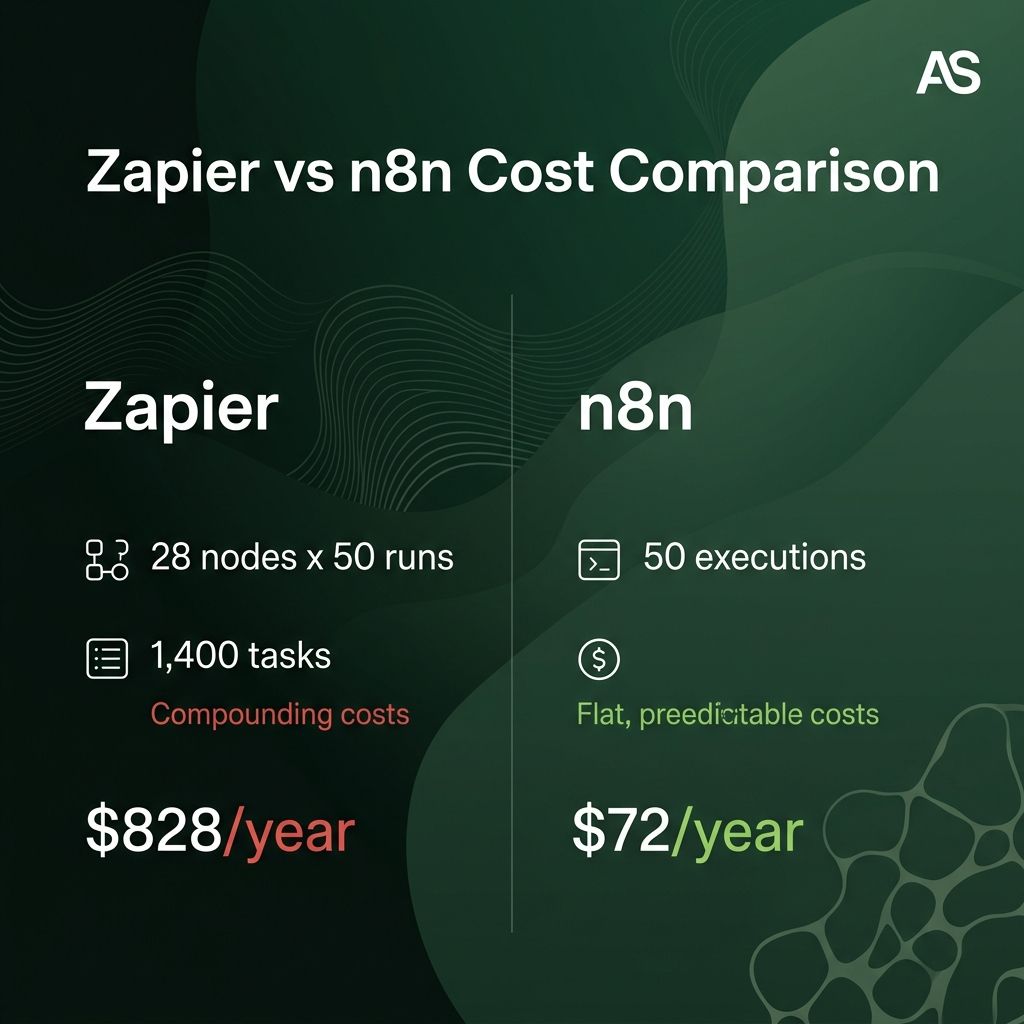
n8n costs ₹0 for software plus ~$6/month VPS infrastructure (~$72/year total). Zapier charges per task, hitting $828/year for the same 28-node workflow processing 50+ monthly leads.
The biggest myth in automation is that n8n is "100% free." The software is free under n8n's fair-code license - unlimited workflows, unlimited executions, zero licensing fees. But running it in production requires infrastructure you pay for.
Here's the real cost breakdown:
| Cost Component | n8n | Zapier |
| Software License | ₹0 (fair-code) | $0 (free tier) → $19.99/mo (starter) |
| Infrastructure | ~$6/mo VPS (DigitalOcean) | $0 (cloud-hosted) |
| Task Pricing Model | Per workflow execution | Per action step |
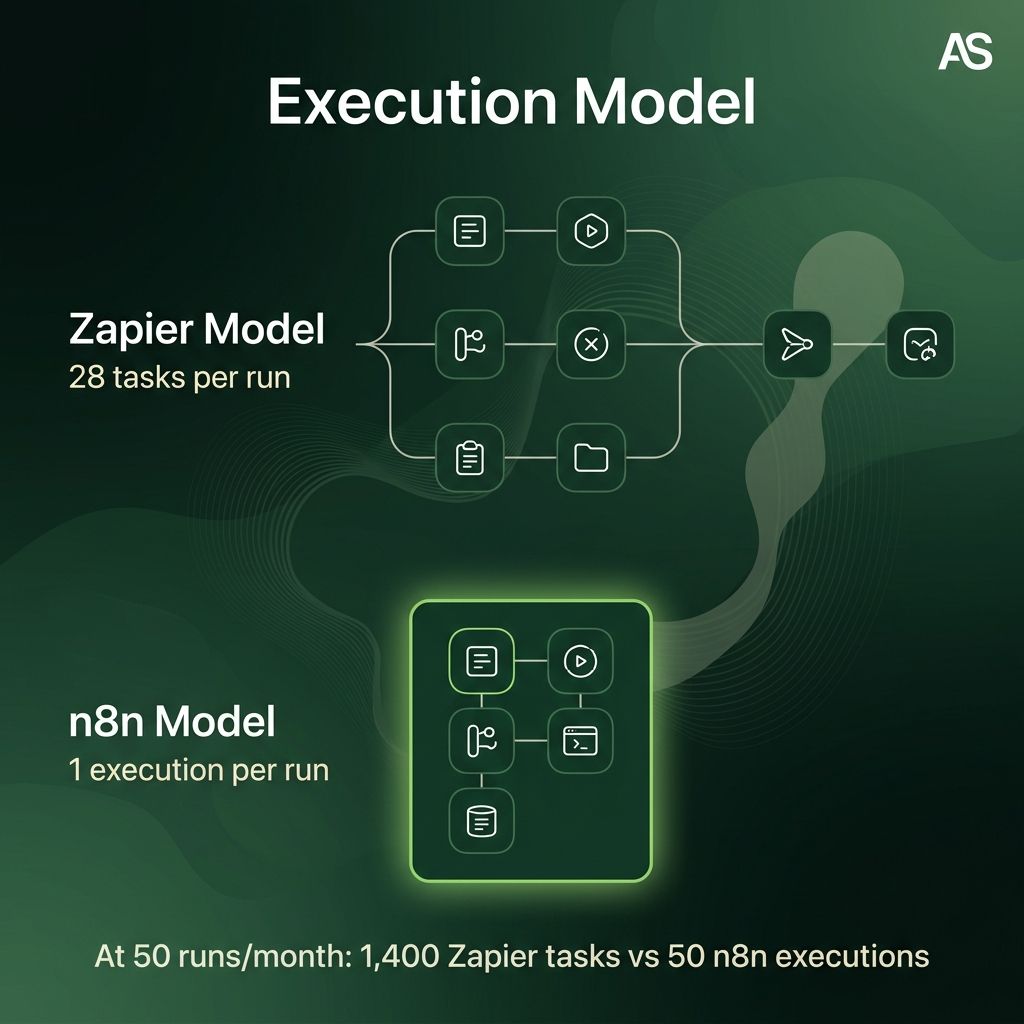
| 28-node workflow cost | 1 execution = 1 unit | 1 execution = 28 tasks |
| 50 leads/month | ~$72/year total | $828/year (scales with volume) |
| 200 leads/month | ~$72/year total | $1,656+/year |
"A 28-node workflow in Zapier burns through 28 tasks per single run. n8n charges per workflow execution - the entire 28-node run counts as one."
The critical insight: Zapier's per-task pricing compounds exponentially with workflow complexity. My lead capture workflow alone had 12 nodes (webhook → validation → Airtable write → email send → Slack notification → error handling). In Zapier, that's 12 tasks per lead. In n8n, it's 1 execution per lead.
At 50 leads monthly, Zapier burns 600 tasks just on lead capture. Add booking management and cancellation recovery, and you're hitting 1,500+ tasks monthly - pushing you into paid tiers fast.
n8n's cost stays flat regardless of workflow complexity or execution volume. You pay for the VPS, period.
(You can run n8n locally via Cloudflare Tunnel for exactly ₹0 during development. But production lead automation handling real revenue needs a reliable VPS with guaranteed uptime.)
Why Did Code Flexibility Become the Dealbreaker?
My 3-layer validation system required native JavaScript execution. Zapier's Formatter would need 6-7 separate steps to approximate the same logic, with each step burning a task and adding failure points.
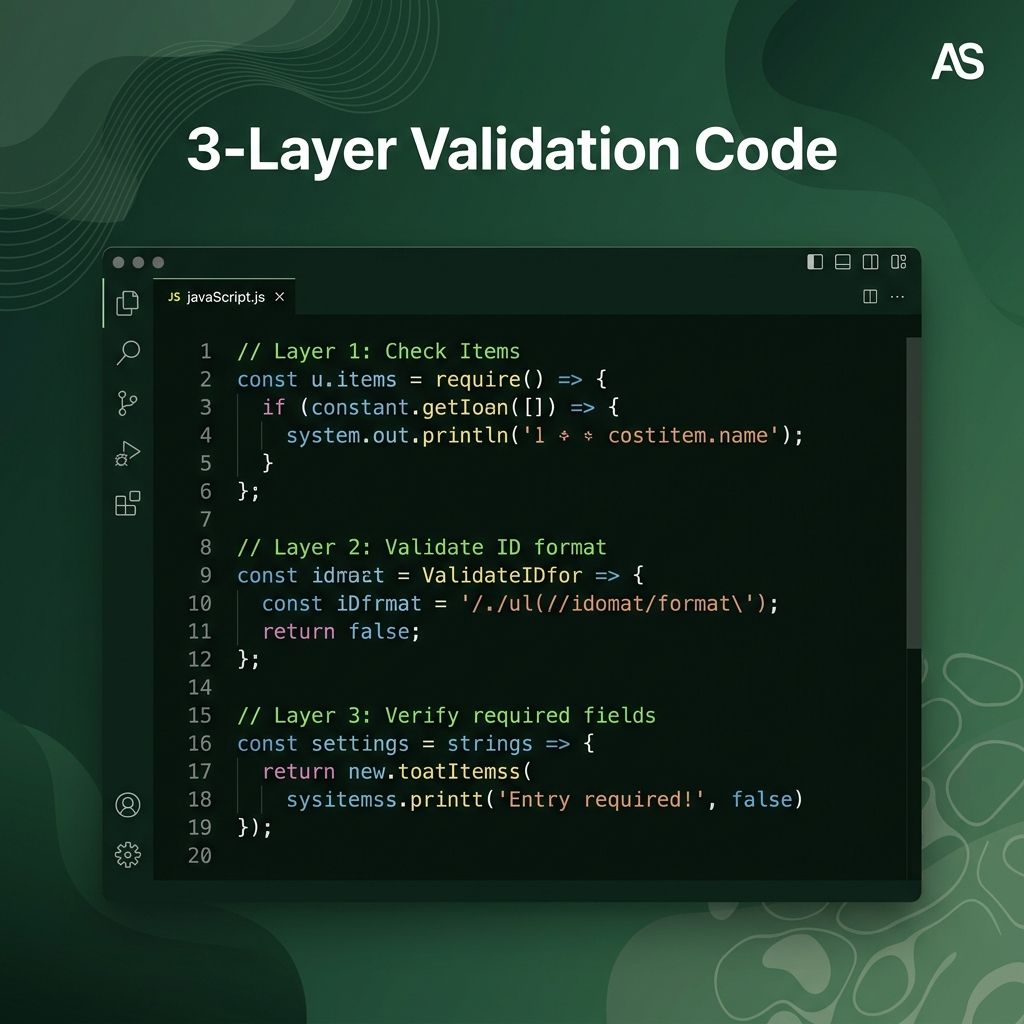
This was the actual dealbreaker. I discovered a critical bug during testing: 40% of Cal.com webhook payloads were arriving as empty objects {}, causing blank confirmation emails. The fix required The 3-Layer Validation Pattern - a custom JavaScript gate that validates payload existence, field types, and required data before processing.
Here's the exact code that saved the project:
// packages/webhook-validator/src/gate.js
// Layer 1: Check if items exist and have data
if (!items || items.length === 0) return [];

// Layer 2: Validate the ID field exists and has correct format
const id = items[0].json?.id;
if (!id || typeof id !== 'string' || !id.startsWith('rec')) return [];

// Layer 3: Verify all required fields are present
const required = ['email', 'name', 'startTime'];
const hasAll = required.every(f => items[0].json[f]);
if (!hasAll) return [];

// Only valid payloads reach this point
return items;
Try building this in Zapier's "Formatter" step. You literally can't. You'd need:
- Filter step to check items array (1 task)
- Formatter to extract ID field (1 task)
- Filter to validate ID format (1 task)
- Formatter to check email field (1 task)
- Formatter to check name field (1 task)
- Formatter to check startTime field (1 task)
- Filter to combine all validations (1 task)
That's 7 tasks to approximate what one n8n Code node does natively. And each additional validation layer adds more tasks, more failure points, and more debugging complexity.
"The 3-Layer Validation Pattern caught an empty object bug that Zapier would have silently passed through - causing blank confirmation emails to real paying customers."
n8n's Code node gives you full JavaScript execution with access to npm packages, async/await, and complete error handling. No sandbox restrictions. No task penalties for complex logic.
What Does Self-Hosting n8n Actually Look Like?
n8n runs on Docker via DigitalOcean VPS with public webhook URLs. You manage infrastructure but gain fixed costs and complete data privacy.
Here's the production setup:
n8n (Docker container)
  ↓
DigitalOcean VPS ($6/mo, 1GB RAM, 25GB SSD)
  ↓
Public IP + Domain (webhook-ready)
  ↓
Cal.com → https://n8n.yourdomain.com/webhook/lead-capture
Airtable → Direct API calls
Email → SMTP integration
The deployment process:
# Pull n8n Docker image
docker pull n8nio/n8n

# Run with persistent data volume
docker run -d \
  --name n8n \
  -p 5678:5678 \
  -v ~/.n8n:/home/node/.n8n \
  n8nio/n8n

# Access at http://your-vps-ip:5678
I chose n8n over Zapier because it eliminated per-task pricing, but I gave up 5-minute setup speed for 30-minute infrastructure configuration. Zapier gets you running in minutes. n8n requires VPS provisioning, Docker setup, domain configuration, and SSL certificate management.
Self-hosting n8n means managing your own updates and uptime, but in return you get fixed costs and zero third-party data exposure. Every lead, every email address, every booking detail stays on your server. For clients handling sensitive customer data, this is non-negotiable.
Where Does Each Platform Win?
Zapier wins on setup speed and non-technical accessibility. n8n wins on cost at scale, code flexibility, and data sovereignty.
Here's the honest breakdown:
Where Zapier Wins
- Setup speed: First workflow running in 5 minutes vs 30 minutes for n8n infrastructure
- Non-technical users: True drag-and-drop, zero code knowledge required
- App ecosystem: 9,000+ pre-built integrations vs n8n's 1500+ native nodes
- Zero infrastructure: Cloud-hosted, always on, nothing to maintain
- Quick personal automations: Slack → Notion, email filters, simple triggers
Where n8n Wins
- Cost at scale: ₹0 software forever, only pay for VPS (~$6-20/month)
- Code flexibility: Full JavaScript/Python execution, any logic complexity, no sandbox restrictions
- Data sovereignty: Everything stays on your server, total privacy compliance
- Debugging depth: Complete execution logs, step-by-step data inspection at every node
- Fair-code transparency: Source code available to audit, extend, or fork
- AI-native nodes: 70+ dedicated AI/LLM nodes including LangChain integration for building agents
- Complex workflows: Multi-step validation, conditional branching, error handling without task penalties
For the Aviators Training Centre project, n8n's advantages aligned perfectly with requirements: complex validation logic, budget constraints, and the need for complete debugging visibility when handling real revenue.
What About LangChain and Agent Frameworks?
LangChain and LangGraph are superior for building intelligent agents with reasoning loops. n8n excels at service orchestration and integration management - they're complementary tools, not competitors.
For building complex AI agents with multi-step reasoning, frameworks like LangChain or LangGraph are the superior path. They give you absolute control over agent state, tool calling, memory management, and decision loops.
But they require heavy coding, and the "no-code speed" disappears entirely. Managing dozens of third-party service integrations (Cal.com, Airtable, SMTP, Slack, Stripe) in pure LangGraph becomes engineering overhead fast. You're writing API clients, handling authentication, managing rate limits, and debugging webhook payloads manually.
My take: For connecting services and orchestrating integrations, n8n remains the best choice. For building intelligent agents that reason and decide, LangGraph wins. They're complementary, not competitors.
(I'm actively building with LangGraph and will share those learnings soon.)
When Should You Choose n8n vs Zapier?
Choose Zapier for quick personal automations under 5 steps. Choose n8n for client projects with complex logic, scaling operations, or budget constraints.
Here's my rule of thumb after building production systems with both:
Choose Zapier when:
- Personal quick automation (Slack → Notion, email filters, simple triggers)
- Non-technical team members need to build workflows
- You need a specific integration from their 9,000+ app library
- Setup speed matters more than long-term cost
- Workflow complexity stays under 5-7 steps
Choose n8n when:
- Client projects with complex validation logic
- Multi-step workflows with 15+ nodes
- Budget constraints require predictable, fixed costs
- You need custom JavaScript/Python logic
- Data privacy requires self-hosted infrastructure
- Scaling operations where per-task pricing becomes punitive
- You're comfortable managing Docker and VPS infrastructure
"The best automation tool isn't the most popular one - it's the one that fits your technical requirements AND your financial reality."
For Aviators Training Centre, n8n was the clear winner: ₹0 software cost vs Zapier's $828+/year (Team plan for 1,400 tasks/month), complex validation logic that needs real JavaScript, 3 interconnected workflows sharing data seamlessly, and a client who needed a system that handles real revenue reliably.
The system now runs at 99.7% reliability, processing 50+ leads monthly, with zero software licensing costs. The $6/month VPS investment pays for itself in the first week compared to Zapier's per-task pricing.
Key Takeaway
Stop choosing tools based on marketing pages. Choose based on your actual production constraints. For a production lead system generating real revenue, self-hosted n8n eliminates punitive SaaS scaling costs while giving you engineering control that no drag-and-drop platform can match.
Bookmark this cost breakdown - you'll need it when your automation scales beyond hobby projects and per-task pricing starts punishing growth.
Project Links:
- Live site: Aviators Training Centre
- Source code: GitHub Repository
- Full portfolio: amansuryavanshi.me
About the Author
I'm Aman Suryavanshi, a Next.js developer and n8n automation specialist. I build production-grade automation systems that handle real revenue for clients. Currently open to Technical Solutions Engineer and Application Product Manager opportunities where I can combine technical depth with client-facing problem solving. Connect with me on LinkedIn or explore my work at amansuryavanshi.me.
Key Takeaways
- n8n software is free but requires $6-20/month VPS infrastructure; Zapier charges $828+/year for equivalent workload
- Zapier's per-task pricing compounds exponentially; n8n's per-execution model keeps costs flat at scale
- Code flexibility is the real dealbreaker: n8n supports native JavaScript for complex validation logic that Zapier cannot handle
- Self-hosting trades setup convenience (30 min vs 5 min) for long-term cost control and data sovereignty
- Choose Zapier for quick personal automations; choose n8n for production systems with complex logic and scaling needs
FAQ
Is n8n completely free?
The software is free under n8n's fair-code license with unlimited workflows and executions. However, running it in production requires infrastructure costs (typically $6-20/month for a VPS). The total cost is still dramatically lower than Zapier's per-task pricing at scale.
Can n8n replace Zapier for all use cases?
No. Zapier wins for quick personal automations, non-technical users, and scenarios where you need one of its 9,000+ pre-built integrations immediately. n8n is better for complex logic, custom code requirements, cost-sensitive scaling, and data privacy needs.
How difficult is it to self-host n8n?
If you're comfortable with Docker and basic VPS management, setup takes about 30 minutes. You'll need to handle updates and monitor uptime yourself. The trade-off is complete control over your automation infrastructure and fixed monthly costs.
What's the real cost difference at scale?
For my 28-node workflow running 50+ times monthly (1,400+ Zapier tasks), n8n costs $6/month while Zapier requires the $69/month Team plan. At 100+ leads monthly, Zapier's costs scale even higher. n8n stays at $6/month regardless of execution volume.